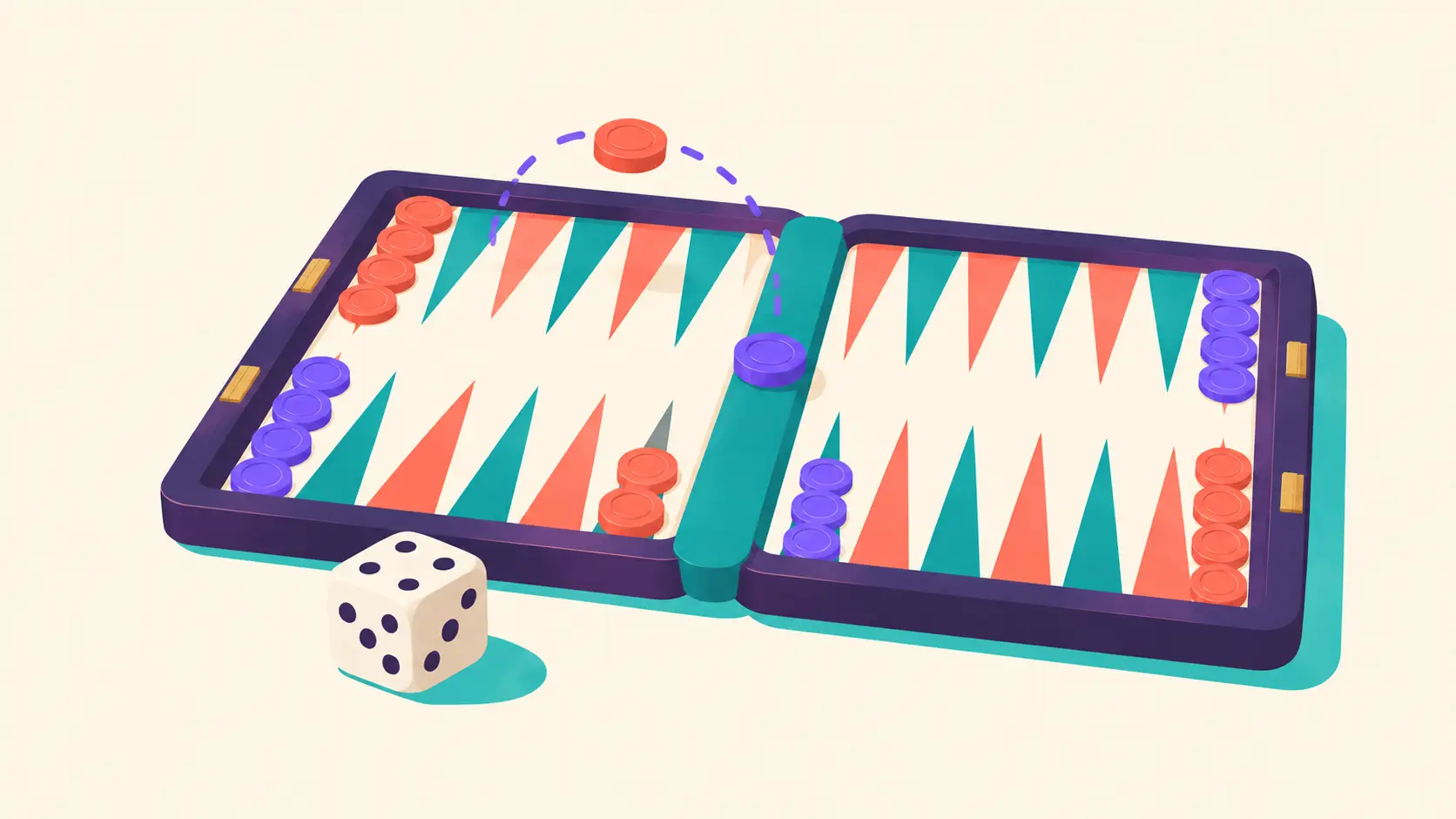
Backgammon is a game for two on a board of twenty-four points, in which each player moves their checkers home and bears them off while preventing the opponent from doing the same. What sets it apart from Narde is, above all, hitting.
What you need
Two players. Fifteen checkers each in one’s own colour, a pair of dice each and a cup for shaking. The board is divided down the middle by a ridge — the bar, which also separates the home board from the outer board. For a game at home that is all you need: any set will do, and the dice can be thrown from the hand.
A tournament is stricter. The dice must be precision dice — cut accurately enough for the faces to come up equally often. They are thrown not from the hand but from a cup, one per player, made of leather, plastic or wood. The checkers are larger than home ones, the board measures 19–21 inches closed, and the playing surface is often leather.
How long it takes. A competitive match played to a set number of points takes from half an hour to several hours.
The starting position
This is where backgammon parts company with narde straight away: the checkers are not gathered into one stack but laid out across the board in four groups — two, five, three and five. Both players have the same setup, turned round mirror-wise: each player’s two farthest checkers stand in the opponent’s home board, and five stand already in their own.
The starting position. White travels counterclockwise and black clockwise, each towards their own home board — which is why one and the same setup looks mirrored.
Who moves first
The opening move is decided by each player throwing a single die. If the numbers come up equal, both roll again until they differ. After that the players alternate, throwing both dice each turn.
How checkers move
The numbers rolled are two moves. A player may take one checker by the sum of the numbers, or two different checkers by each number separately. Both numbers must be played if that is possible; if neither can be played, the rest of the turn is forfeited. And when only one of the two can be played, it is the larger that must be played — the player has no choice here.
Rolling doubles — the same number on both dice — plays that number four times, not twice.
The opponents travel in opposite directions: white checkers move counterclockwise and black checkers clockwise, each towards their own home board.
A point counts as held when two checkers of one colour stand on it: the opponent may not move there.
Hitting and the bar
A point holding exactly one opposing checker may be taken — such a checker is called a blot. Whoever moves onto it hits the blot, and the checker that was hit goes to the bar.
While a checker sits on the bar no other move may be made: it has to enter the board first. A checker that has entered starts its journey afresh and must travel all the way around the board back to its own home board.
On the board it looks like this, and it also shows what the hitter pays for the hit.
White — on the bar: 1
The marked point is where a lone white checker stood: black hit it and it went to the bar. While it sits there no other white checker may move; the black checker that hit it now stands alone itself.
How likely a hit is
Two dice have thirty-six outcomes, and almost all the arithmetic of the game is counted in thirty-sixths. A particular number — a four, say — comes up on at least one die in eleven rolls out of thirty-six, roughly a third of the time. A particular double comes once in thirty-six rolls, about 2.8%. A total of seven is made by six rolls out of thirty-six.
From this comes the number worth remembering whenever you leave a blot: six points away and seven are different worlds. A blot six points away is hit by seventeen combinations out of thirty-six — nearly every second roll. A blot seven points away, by only six: there is no direct shot from there, and the hit takes a combination of both dice or a double.
Bearing off
Bearing off begins once all of a player’s checkers have reached home: a checker is taken off the board by the number rolled. If no checker can be borne off, the player must make another legal move inside the home board.
The first player to take every checker off the board wins.
How points are scored
Each game starts at one point, and the price then depends on how heavily the loser lost.
- A plain win — one point: the loser bore off at least one checker.
- A gammon — two points: the loser bore off no checker at all.
- A backgammon — three points: the loser bore off nothing and still has a checker on the bar or in the winner’s home board.
The result of the game is multiplied by the value of the doubling cube.
The doubling cube
The doubling cube belongs to play for points: it lets the stakes rise during a game. At the start the cube lies halfway between the players with the number 64 face up.
A player who thinks their position is good enough may offer a double — but only on their own turn and before throwing the dice. The opponent either accepts, and the game continues at twice the stakes, or refuses, conceding the game and paying one point. Whoever accepts becomes the owner of the cube: only they may offer the next double in that game.
The Crawford rule. When one player comes within a single point of winning the match, the following game is played without the cube. After it the cube is back in play.
The Jacoby rule applies to money play and never to match play: a gammon or a backgammon does not count for more than a plain win unless the cube has been turned in that game.
Beaver is also a money-play rule, not a match one: on accepting a double, a player may immediately redouble in return while staying the owner of the cube. Automatic doubles — the stakes double before play begins if the opening roll is a double — belong to money play the same way, alongside beaver and the Jacoby rule, and are absent from match play.
Three or more players at one board play a chouette: one sits against all the others, who move through a captain. → Chouette and team play
Order at the board
At home nobody thinks about this; at a tournament it is all written down — and it is worth knowing at home too, because a fair share of disputes is settled not by a rule of movement but by the order of the roll.
The roll. The dice are shaken thoroughly, thrown together and to the player’s right, and they must come to rest flat. A die that lands cocked — propped against a checker or against the side — voids the roll, and both dice are thrown again. Re-rolling only the bad die is not allowed.
How the shaking is done. Both dice go into the cup, the cup is covered with the fingers, and it is shaken at least three times.
A move is made once the checker is released. While the checker is in hand the decision can still be changed; after it has been let go, the move is not taken back.
While the opponent moves, the board is not touched. Tournament rules put it literally: a player waits without moving, touching neither the board, nor the dice, nor the checkers.
Spectators keep silent. Anyone watching a match is required to stay quiet. If a spectator interferes — with noise or with distracting movement — the player may ask the tournament director to keep that person away from the match.
The clock. At a tournament the match is played on a clock, and a player whose time runs out before the match is over loses the match.
The score is written down. If the player who won points forgot to record them, both the referee and the spectators may say so: that is restoring the record, not coaching.
Checkers are moved with one hand. The requirement sounds petty; its point is practical — the opponent must be able to see what you actually did.
No outside help. At a tournament electronic, mechanical and written aids are forbidden, with the score and move record the only exception.
Disputes go to the tournament director, and an appeal is immediate. A player may appeal his decision, but must do so at once, not after the game. The director may replace the board or other equipment at any time, and being on time is the player’s own responsibility, not the referee’s. The winner reports the result to the tournament committee.
The dice themselves. There is a separate requirement — dice must be balanced. That is a condition of fair play, not fussiness about equipment.
Varieties of backgammon
Backgammon has relatives: games on the same board with the same checkers, differing in a detail or two. Below are the ones whose difference can be named exactly. All of them are played by the rules above, except where stated.
Turkish tavla. Tavla is the Turkish name for backgammon, and the word itself means “board”. It is played on the ordinary twenty-four point board, the players move towards each other, hitting and the bar work the same way, and every checker must reach home before bearing off starts. There is one difference, and it matters: bearing off is compulsory. If the roll allows a checker to be taken off, the player must take it off and may not move a checker inside the home instead. In narde, by comparison, no such compulsion exists.
Nackgammon. Differs only in the setup: four checkers stand at the back instead of two — two of them move from the twenty-fourth point to the twenty-third. Everything else is backgammon, but escaping from behind the opponent becomes harder.
Longgammon. All fifteen checkers start on the opponent’s one point, the doubling cube is used, and the other rules are unchanged. The game turns into a long race from the far edge of the board.
Plakoto. The Greek relative, in which a checker is not hit but pinned: landing on a single opposing checker holds it in place until you leave. Both sides start on the opponent’s one point and move towards each other. The last checker on the starting point is called the mother, and if both mothers are pinned the game is a tie.
Plakoto Express. Plakoto with a different handling of doubles: the numbers you cannot play do not vanish but pass to your opponent, who plays them for himself in the same order in which you were required to play them.
Acey-deucey. Begins with an empty board: every checker is entered during play. A roll of 1-2 is played as an ordinary roll, after which the player chooses any double, plays it and rolls again. The last remaining checker is nicknamed Oscar.
Eureika. The furthest from backgammon: the checkers do not travel round the board at all. Each player places them on his own points — three each on the first, second and third, two each on the fourth, fifth and sixth — and bears them off directly by the numbers rolled. The winner is whoever bears all of his off first.
Comments