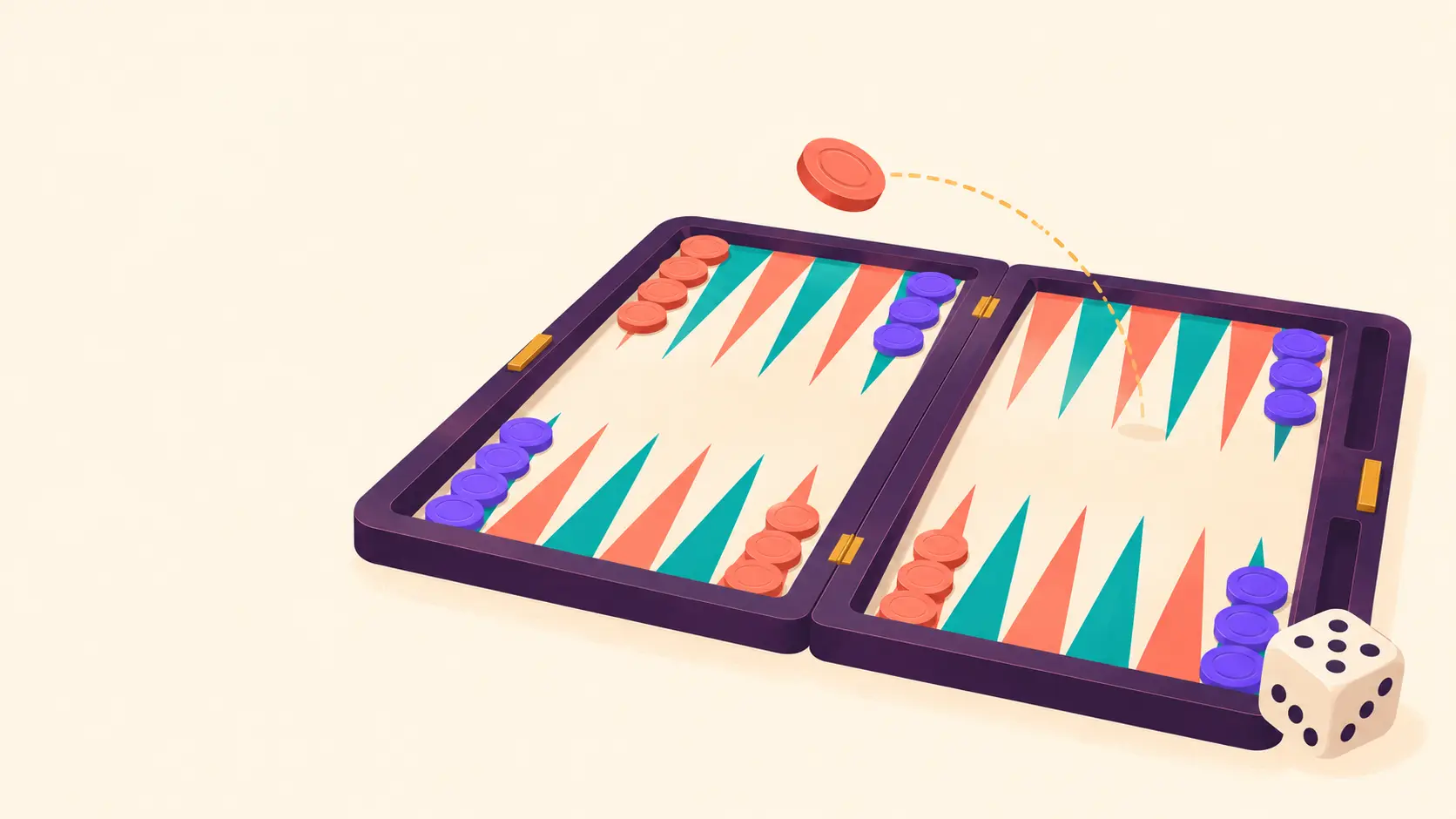
Narde is a race: the players never hit each other, they outrun each other. The rules below come in the order you need them at the board — what to prepare, who moves first, how checkers travel, what is forbidden, and how the game ends.
What you need
Two players. A board, fifteen white and fifteen black checkers, and two dice. Each player’s checkers are a single colour — usually black and white.
The object of the game
Bring all of your checkers around the board into your home — the last six points on their path — and bear them off before your opponent does. There is no hitting and no trapping in Narde: the game is a pure race.
The starting position and the head
At the start of the game all fifteen of a player’s checkers stand on a single point, and that point is called the head. Nothing else is on the board: the whole game is spent spreading that stack out one checker at a time. Both players’ checkers travel in the same direction, counterclockwise, from the head towards their home.
The opening position: every checker of each side stands on its own head. From there both travel the same way round, counterclockwise, each towards its own home.
Who moves first
The opening move is decided by each player rolling a single die: whoever rolls higher begins. On a tie the roll is repeated. The values rolled for the lead are the ones played as the first move.
After that the players alternate, rolling both dice each turn. The dice must land flat on an empty part of the board, on one side of the bar. If a die leaves the board, the dice come to rest in different halves, a die lands on a checker or does not lie flat, the roll is void and repeated.
How checkers move
The numbers rolled are two separate moves. A player may make them with different checkers or with one checker in succession: first by one number, then by the other. On a double — the same number on both dice — the roll counts twice over, and the player makes four moves.
Moving is compulsory, and the rule is stricter than it looks:
- if both numbers can be played, playing only one is not allowed;
- if two moves are possible and one of them uses both dice while the other uses one, the one using both must be played — the full-move rule;
- if only one of the numbers can be played, the higher one must be played;
- a move may not be declined, however unwelcome it is.
Skipping a turn is legal in exactly one case: when no move at all can be made.
The head rule
Only one checker may leave the head per turn. The single exception is the opening turn on a double of 3-3, 4-4 or 6-6: two checkers may then leave the head.
What is not allowed
A point holding even one opposing checker is closed: you may not move onto it. Nor may you hit that checker — hitting does not exist in Narde, so a lone checker holds a point as firmly as several do.
From that follows a second restriction that backgammon does not have: an unbroken row of six of your own checkers may not be built if the opponent has no checker ahead of it along their path. A wall that locks the opponent in completely is forbidden.
This rule is easier to read off the board: what matters is not the row itself but what stands in front of it.
A row of six points held in succession is legal: the marked checker is the opponent’s one that got past in time and stands ahead of the wall. Take it away and the same row becomes forbidden.
Bearing off
Bearing off begins once all fifteen of a player’s checkers have reached home; before that, no checker may be taken off. From then on the numbers rolled may be used either way: to move a checker inside the home or to bear it off the board.
If the point matching the number rolled is empty, a checker is borne off from the nearest occupied lower point — but only once no checkers remain on the higher points. The case is a common one, and the board shows it more plainly than the wording does.
White — borne off: 5
The marked point is empty, and the number that fell on it takes a checker off the nearest occupied point: nothing is left behind it in the home. Were even one checker there, that checker would have to be moved instead.
The game is won by the player who first bears every checker off the board.
How points are scored
A plain win is worth one point, and a heavy defeat costs more.
- Oin — one point: the loser managed to bear off at least one checker.
- Mars — two points: the loser bore off none.
- Coke — three points: the loser bore off nothing and every checker of theirs is still in the starting quadrant.
Home Mars is a folk name for a mars in which the loser did get every checker home yet bore off none. It does not count as an outcome of its own: no international rules and no tournament regulations know the notion, and where it is used the price wanders from 3 to 10 points.
A draw is not provided for by the rules of the game: it is possible only under a tournament’s regulations, and then the players take either half a point each or one point each.
What to settle before the game
Narde has no single governing code: different schools play differently. At the board it shows in one place — the price of a coke. Some players know only two outcomes, oin and mars, and a game in which the loser bore off nothing is worth two points to them wherever those checkers stand. If you play for score against an unfamiliar opponent, agree beforehand.
Comments