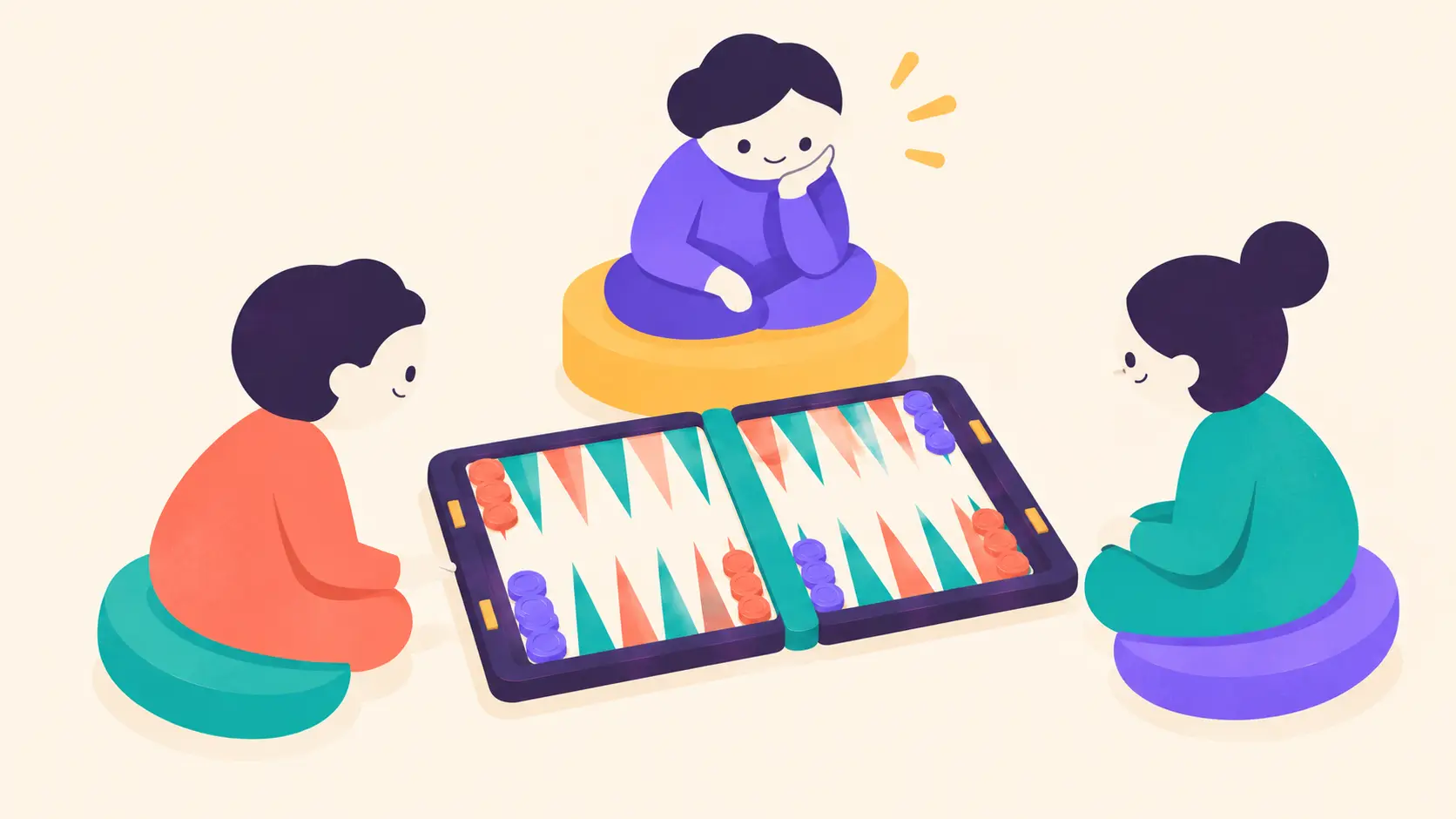
A chouette is backgammon played by more than two. One person sits against everyone else: they are the box, the others are the team. Any group of three or more with a board and an agreed stake can start one.
A chouette is the most civilised and social form of the game. The word is French for owl: the lone player is likened to an owl, mobbed by other birds. There is a cheerier reading too — a chouette is for clever people, and the owl is a symbol of wisdom.
How it works
The game against the box is played by the captain, one of the team; the rest are called the crew. The roles are not fixed: they change after every game, and that is what keeps a chouette alive and fair over an evening. It also brings a convenience that head-to-head play lacks — it is easy to join a chouette midway and easy to step out for a while without abandoning anyone.
The team consults; the box does not. That is its advantage: the position can be discussed out loud. The captain is to be clearly advised, but the final decision is theirs, and the team accepts it.
The box has the opposite advantage, and it is no less real: there is nobody to argue with. It plays one set of moves, and internal disagreement never enters its game.
How a chouette is run
The box keeps score with each player separately: winning, it collects from every member of the crew; losing, it pays each of them. There is one game on the board and as many settlements as there are people across it.
Roles change by result, not by turn. If the box wins, it stays in the box, the captain goes to the back of the line, and the next member of the crew becomes captain. If the team wins, the box goes to the back, the captain takes the box, and again the next player becomes captain. The winner stays put: a strong player can sit in the box all evening. The captain, though, is new every game — either demoted or promoted into the box.
The acting captain. If the captain drops the cube while the others play on, the game is finished by the next player in line, as acting captain. Whatever this game does, that player is also down to be captain in the next one; if the acting captain drops out too, the role passes further along the line. The mirror case: the box declines the captain’s double while the crew plays on — then the captain sits out the rest of the game but takes the box after it.
There may be one cube, or one per player. With multiple cubes the box doubles crew members individually, each decides for themselves whether to take or drop, and each may double the box in turn. With a single cube the captain decides, but the crew keeps a right of its own: when the captain drops, any of the others may take and carry the game on for the team.
The stake is set per point, and a chouette is almost always played for money: at the end of the game everyone pays or collects on their own score.
Two details for a large group. A proxy is the deputy of a player who has stepped away, holding the cube on their behalf. A partner is the box’s right to take someone alongside, granted when the group is large — usually six or more.
And the thing to settle in advance: there is no universal set of chouette rules. Clubs settle disputed cases differently, which is why they are better agreed before the first game than after it.
The box: profitable for a strong player, expensive for a weak one
Strong players often like the box, because their edge there is amplified. For exactly the same reason the seat is dangerous: the box plays the whole team, and that much more is at stake. A loss is multiplied across every member.
Taking the box is worth being selective about: it is a high-variance position. At high stakes, or with several doubles, the amounts facing the box get substantial — in both directions.
That yields the one numerical piece of advice there is, and it is about the wallet rather than the board. Kleinman: playing a chouette at a 5 euro stake, carry 1000 euro and be ready to lose it. In another of his books the same thought is put differently — be ready to lose 200 points.
The cube decides more than in a two-player game
On this there are no two views: cube decisions in a chouette matter more than head-to-head, and strong cube handling matters more than ever. The reason is the same arithmetic — the box’s error is multiplied across every member of the team.
There is also a device that two-player games do not have: separate cubes. When several doubles are offered, the box may accept some and decline others — say, two out of four. That lowers its financial risk and raises its chances: four eyes see more than two. The chouette rules in the old Backgammon Book are outdated for precisely that reason: nearly everyone now plays with separate cubes.
Another point named separately: dropping a marginal take. In a chouette, declining a doubtful take is usually right, because the box plays alone — which is a slight advantage to the team.
And there is a phrase of its own: giving for game — an offer made by a player who wants to double the box when the others do not.
The Jacoby rule is required here
In a chouette the Jacoby rule is taken as standard unless agreed otherwise, and is called essential to fair and interesting play. The reason is concrete: without it, the box or the captain could deliberately hold the cube in gammon-heavy positions to extract the maximum. Understanding the rule is advised for anyone who plays for money or in chouettes.
Ethics: where the format is vulnerable
One case deserves separate treatment, and it is about people rather than checkers. A team player advises the captain not to double, knowing perfectly well that the captain will double anyway — and thereby tempts the box into an unwise take. That is unethical.
And the mirror remark, also about money: a player whose take was technically wrong will most likely lose, and lose considerably more than by simply playing on against the box.
Why a chouette is worth playing
It is entertainment and instruction at once, and the second more often than the first.
- it is the best way to discuss strategy, cube decisions and checker plays in real time;
- hearing experienced players think aloud about the same position accelerates your own improvement;
- players who are not yet strong have plenty to learn from the strong, and the learning happens by itself, through the discussion;
- a chouette is fast, sociable and full of intrigue: everyone is involved in every game, even when it is not their turn to captain.
This is how most serious club players prefer to play. The easiest way to try one is a local club: most of them run chouettes on club nights.
What a chouette does not have
The internet. The format transfers badly online, and the reason is stated: it rests on live discussion, multiple cubes and flexible roles. None of the three reproduces properly on a screen.
Easy counting. By the end of a tournament day, or in a chouette that runs all night, working out the pip count becomes an ordeal.
The cube itself is on the cube page, and counting the race on the pip count page.
Comments