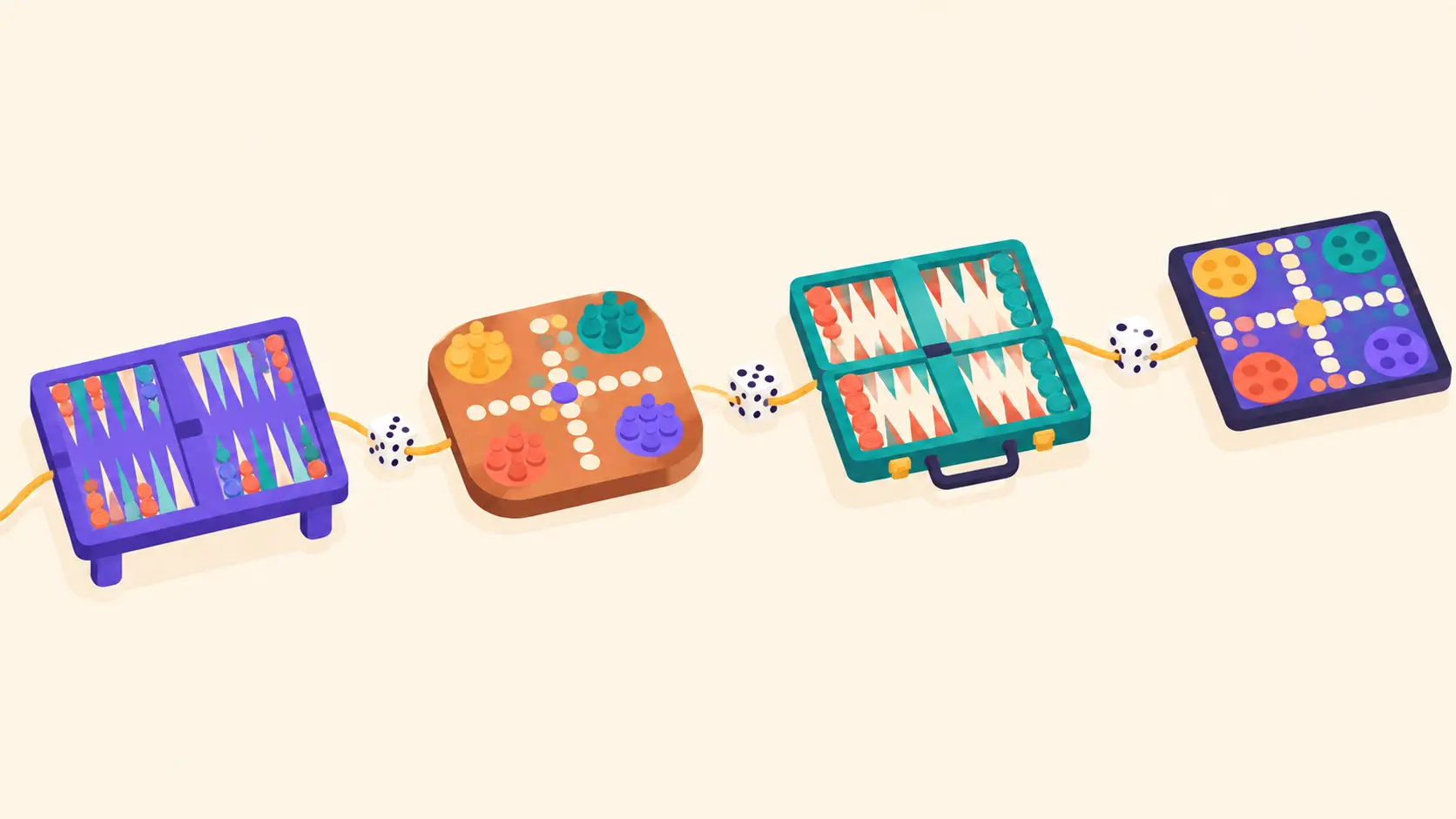
Narde is older than almost anything else we play today. Its predecessor is traced to the time of Ur in Mesopotamia, and in one form or another the game has been played for over 5000 years — by some accounts almost a thousand years longer than chess.
What follows is what is known for certain about the game’s history, where the certain part ends and legend begins, and which dates are still given differently.
Five thousand years, and one dispute about the place
The game’s route is almost always described the same way: Mesopotamia, Egypt, India, Greece, Rome, the Middle East, Europe, England, America.
But they name the starting point differently. Some point to Ur in Mesopotamia — it was there that people played the predecessor of backgammon 5000 years ago, and in the Royal Game of Ur they used tetrahedral dice, not the familiar six-sided ones. Others name the Iranian “Burnt City” (Shahr-e Sūkhteh) in Sistan and Baluchistan: finds there date the predecessor to around 3000 BCE — according to this version, the game is even older.
A more cautious version of the same: the game appeared more than 5000 years ago “somewhere in the East”.
Egypt stands apart in that list, because there the game has a name. Ancient Egypt played senet — a race game called either a distant relative of backgammon or its possible ancestor. Its age is given differently too: 3500, 3000 and 2650 BCE all appear. And in the tomb of Tutankhamun, opened by Howard Carter in 1922, the grave goods included boards for games resembling backgammon, dated to around the 15th century BCE.
The legend of the vizier who invented the game in ten days
Narde has no author, but it has a legend. A Persian text attributes the invention of the game nard to the vizier Bozorgmehr Bokhtagan, who served Khosrow — the ruler from 531 to 579.
The same story is told in Turkish in almost the same words: the vizier took apart the chess set sent from India and, in reply, invented tavla in ten days. It is a legend, not a document, and is worth reading as one.
And the legend disagrees with itself. The «Shahnameh» of the Persian poet Ferdowsi, written around 1000 AD, praises not the vizier but Burzoe for inventing nard in the 6th century. The same century, a different man — and both versions are still in circulation.
The board that was read as a calendar
The board has another reading, one that has survived to this day in retellings: it is built to the measure of time. Twenty-four points for the twenty-four hours of a day; twelve points on each side for the twelve months; four quarters of the board for the four seasons; thirty checkers for the thirty days and thirty nights of a month.
Whether that is design or coincidence cannot be settled from the board itself. But the reading is an old one, repeated in different countries, and everything countable on the board fits it.
Rome, Byzantium and «Tables»
The Romans had a game almost identical to the modern one: three dice instead of two, and checkers moving in a single direction. It was called tabula, and its predecessor is held to be the older Roman ludus duodecim scriptorum — the “game of twelve lines”. In England it was known as Tables, and by the 13th century Tables was played all over Europe.
How widely is visible from the bans: in 1254 Louis IX issued a decree forbidding his court officials and his subjects to play games of this family.
Byzantium left the earliest literary evidence: a game of the tables family called tavli (τάβλι) is described in an epigram of Emperor Zeno, who ruled in 476–481.
From there the game is traced through documents and objects. Several games of this family are depicted in the Spanish «Book of Games» with detailed explanations. A wooden board with checkers was raised from the sunken ship «Vasa» — among the personal belongings of officers. The direct ancestor of backgammon is held to be the medieval Anglo-Scottish game Irish, known since the 16th century. By the 17th century the games of this family had spread across the whole of Europe and reached Sweden — which is how a board came to be aboard the «Vasa».
The name of the game, and dates that do not agree
Most scholars derive the word backgammon from Middle English baec gamen — “back game”: checkers sent to the bar return to the start of their path. Another theory traces it to Welsh: back meaning “little”, cammon meaning “battle, war” — together, “little war”.
Neighbours have their own name for it: the Italians call the game tavola reale, the Spanish tablero, the Turks tavla; the Greeks called it diagramismos (διαγραμισμός).
The game took its modern shape at the start of the 17th century, and the historian of board games H. J. R. Murray goes further, writing that this is when it was invented, in England.
When the word was first written down is given differently: citing the Oxford dictionary, both 1647 and 1650 appear. The text named is always the same one — James Howell’s “Familiar Letters” (Epistolae Ho-Elianae) — yet that too is dated to 1635 by some and 1645 by others. Four dates for a single reference, and no accepted one among them.
The history of the first sets of rules is the same. The set standing closest to modern backgammon was published in France under the name toute-table in 1699 — by another dating, in 1669. Edmund Hoyle’s treatise on backgammon is dated to 1745, the “Short Treatise on the Game of Backgammon” to 1753, and by a third account Hoyle established the rules of the most widespread European variant in 1743. Three dates for one man and nearly one text — commonplace for that era.
Rules by which the game is played today
The game reached the United States in the 18th century, and the modern rules were established in the 20th. The 1931 rules, prepared by the New York Racquet and Tennis Club, laid the foundation for how backgammon is played today. Those same years brought the first surge of fashion for the game — the 1930s; the second, far louder one, would come forty years later.
The same period produced the youngest rule of the game — the doubling cube. It emerged in the early 20th century, most likely in the gaming clubs of New York’s Lower East Side, or by another dating in the 1920s; its author is unknown. The cube is a relatively recent innovation, and it is precisely this element that added an entire dimension of skill to the game: the decision to “double or not” is worth more than most moves.
Match play was completed by the Crawford rule — a standard part of a match, devised by John Crawford, co-author of «The Backgammon Book».
The sixties and seventies: the game becomes fashionable
Modern tournament history begins with Prince Alexis Obolensky. He founded the World Backgammon Club of Manhattan, devised a tournament system in 1963, and in March 1964 ran the first major international tournament — drawing royalty, celebrities and the press. He is remembered as the “father of modern backgammon”, and he co-founded the International Backgammon Association as well.
The first World Championship took place in Las Vegas in 1967, and Tim Holland was declared the winner — he won again in 1968.
In the 1970s, the game experienced a surge in popularity unlike any before. Hugh Hefner’s parties at the Playboy Mansion were held to be the place to be, and Paul Magriel, nicknamed “X-22”, turned strategy from something intuitive into something worked out — author of the book Backgammon and the dominant player of the 1970s and 1980s. Magriel passed away in March 2018 in Las Vegas.
The list of champions itself is short and specific. John R. Crawford has won one international championship. Magriel himself won the World Championship in 1978 and more major tournaments than anybody else on the circuit. Nack Ballard is the only player to win the World Championship three times. And Bill Robertie, the only two-time winner of the Monte Carlo World Championship, is called the strongest player in the game’s history.
The computers that changed the game
It started not with artificial intelligence, but with one champion’s challenge. In 1979, one day after winning the World Championship, the Italian player Luigi Villa accepted a challenge to play against BKG 9.8, a program developed by Hans Berliner.
In the 1990s programs themselves sat down at the board. The first neural network was TD-Gammon, developed by Gerald Tesauro, an IBM researcher; the first commercial neural network program was Jellyfish in 1994.
Real-time play over the internet began in 1992 with FIBS (the First Internet Backgammon Server).
By the beginning of the 21st century, the game had split into “two worlds”: the traditional home game and the computer-optimized competitive scene. They diverged not in rules, but in what was considered a good move.
At the same time, computers settled the long-standing debate about the nature of the game — at least legally. In 1982, the case State of Oregon v. Ted Barr concluded that backgammon is a game of skill, not a game of chance.
Online play brought in the Elo rating system: invented in 1960 by physicist Arpad Elo for the U.S. Chess Federation, it is used by many backgammon servers today to measure a player’s strength.
Where the game lives now
The annual World Championship is run by the World Backgammon Federation (WBF) in Monte Carlo; the tournament typically attracts 300–500 players from over fifty countries and awards a substantial prize fund. The world title is not the whole calendar: European and world championships are held regularly, every year. But the game’s main life is not the tournament one: backgammon remains an ordinary fixture of coffeehouses across the Eastern Mediterranean, and in Turkey tavla is one of the most popular games of all, played in cafés, clubs and homes throughout the country. Afif Bahnassi, Syria’s director of antiquities, said in 1988 that the game became the rage of the Ottoman Empire and spread with the Turks across the Arab world, remaining there after they left.
The region has a habit of its own, too: dice rolls are called out in a mixture of Persian and Turkish numbers rather than in the local language.
And in the Russian-speaking world the word «нарды» carries two meanings: there are two main varieties — Narde and backgammon. What is above is the history the two share; their rules differ.
Comments