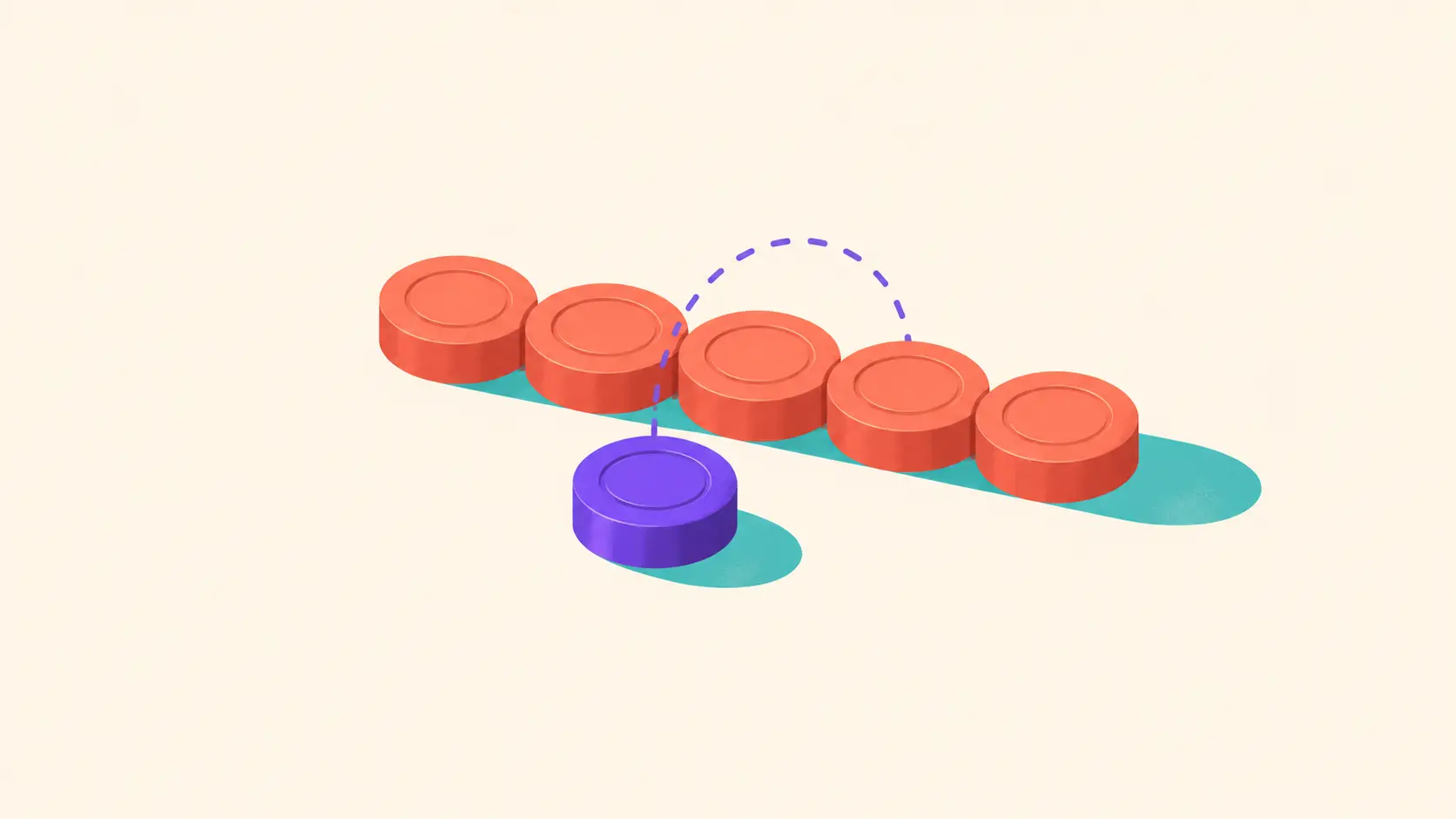
What is a barrier and why is it stronger in Narde than in Backgammon, explained on Strategy page]. Here — details: how many checkers are needed, where to place them, what makes a barrier vulnerable, and how to break it.
A fence is a row of points, not a stack of checkers
In Narde, a point holds one checker: it cannot be hit, and a second checker adds nothing to reliability. Therefore, a “fence of four checkers” means four consecutive points each with one checker, not four checkers on a single point.
From here also comes the cost: each point of the barrier costs you a checker removed from other positions. A barrier made of six checkers is nearly half of your forces stationed in place.
Scale: how many checkers make a barrier dangerous
The scale here is clear, and the difference between adjacent steps is qualitative, not quantitative.
Three checkers — not yet a threat
A fence made of three checkers does not pose a serious threat to the opponent. But placed in the right position and combined with another fence or other advantage, it works quite effectively. It is most useful at the beginning of the game and in the opponent’s home board.
Three points are occupied, and the opponent still bears off three numbers out of six from the head.
Four checkers — a cause for concern
A barrier made of four checkers is already by itself a serious cause for concern for the opponent. Its strength depends on how many checkers the opponent has left on the Head at the moment of placement: the more, the worse for the opponent.
And the same barrier, placed in the right position, changes the game. If four occupied points block the opponent’s move from head to 3, 4, 5, and 6, this ensures Mars with roughly 70% probability. Diagram of such a position is on page strategy].
Fences are most effective at the beginning of the game precisely where they block the opponent’s higher-point moves from the Head. When the higher points are blocked, his free checkers are forced to move far away, and he almost loses the opportunity to establish “paths” for captures.
Five checkers — very dangerous, but not certain
A fence made of five checkers is dangerous almost anywhere. In one’s own home it becomes a solid wall—impassable. But placed at an opponent’s head, it leaves the opponent exactly one point, and it is precisely this “one point” that constitutes his weakness.
Five consecutive points occupied. One six remains to the opponent’s head—and the marked point beyond the barrier, to which she bears him off.
Here is the most practical correction in this topic: you must block not only the points of the barrier, but also the point beyond it. A barrier of five checkers is vulnerable to successful hits: if your opponent has accumulated enough checkers in front of the barrier, a hit with sixes can erase all your advantage, and sometimes even turn the game in their favor. Blocking the point beyond the barrier eliminates this risk.
Six checkers — Mars, if the rules allow
A fence of six checkers in the opponent’s home board or in one’s own home means Mars, which the opponent can avoid only by a miracle. A complete fence of six means for him a loss of all points — one hundred percent.
But the rules set a boundary here, and it is important: a continuous row of six of your checkers cannot be built if there are no opponent’s checkers ahead along the path. More details — on page of rules]. The practical meaning is that a solid barrier of six is legal only when at least one of the opponent’s checkers has already passed by — and that checker becomes their sole hope.
Six points in a row, and the opponent cannot bear off a single checker. The fence is legal because one of his checkers has advanced forward.
The fence can also be not solid
Important nuance: a barrier does not have to be continuous to work. It can leave just one move to overcome—and then it is almost as effective. If the barrier is incomplete, the opponent’s losses are counted by the number of moves needed to pass through it, and all rules on this page apply to such incomplete barriers as well.
Where to place: attack or defense
Barriers divide by position, and the difference determines what you are playing for.
A fence at the opponent’s head — an attacking move. If successful, it brings a Mars: the opponent fails to bear off a single checker.
A fence at a rival’s home — defensive. Even a successful one brings only a simple win — Oin. It prevents the opponent from bearing checkers home and forces him to lose points on entry.
This does not mean that a defensive wall is unnecessary. It creates a serious shortage of moves for the opponent and helps build an attacking position—that is, it works as preparation. A wall in one’s home is usually built under cover of an existing wall in the opponent’s base.
And the reverse side: everything said about capturing points at the opponent’s head must be taken into account for one’s own defense, blocking the same strategic points at one’s own head.
How to build
- Take a point adjacent to your checkers. If there is a choice, the one that extends the wall is better than the one standing separately.
- You can build even with checkers not adjacent to the wall. Completing the wall with checkers that do not border it is a separate tactic: it increases the advantage the wall already provides.
- Accumulate checkers at the ends. This is necessary so that, with a given roll or a hit, you can cross the wall yourself — the wall hinders you as well.
- Build gradually. First build three or four points in a row, and keep checkers near the gaps.
- Don’t rush to extend at the expense of the future. It’s better not to extend the wall now if the next bad roll will force you to dismantle almost everything built.
There is also the moving prime — a barrier made of four to six points, which is advanced forward, toward one’s home, without releasing trapped checkers. It is the same barrier, named from a different perspective: keeping opponent checkers behind the wall while one expands one’s own position.
Fence and shortage of moves
This is the main reason why a blockade is stronger than it seems. Any blockade — is a tool for creating a shortage of moves for your opponent, and simultaneously a source of reserve moves for you: inside the blockade you have many options, and it is hard to corner you into a losing position. A blockade facilitates the creation of selective shortage — that very number your opponent lacks.
It also has a requirement. The barrier must be supported by something. To work, the opponent must not create comparable difficulties in the rest of the board, and you must have a sufficient number of moves available. A barrier without extra moves will dismantle itself.
Especially acute is the shortage of moves felt during a “wall war” and when trying to hold a key point.
How to Deal with an Opponent’s Barrier
- Hold the first and second point of the barrier. This is the main principle: the second point is especially important, and you should always occupy it whenever possible.
- Build up before the barrier. Checkers standing in a stack before the barrier are what will help you overcome it when the right number or a double comes up.
- Break the farthest checker first. When breaking a checker trapped by the barrier, start with the farthest one—except in very rare cases.
- Look for counter-threats. If your opponent is building a Mars barrier near your head and you can’t stop it, sometimes you can create a threat even more dangerous for him than his barrier is for you. If he blocks your checkers on your head, build a dangerous barrier in his home.
- Know when to reorganize. If his checkers start entering your home through the barrier, you must quickly reorganize the barrier, moving all your checkers. If he builds a composite barrier against your Mars barrier on the higher points in his home, move your barrier into your home, opening up his higher route from the head.
- Don’t block meaningless moves. Blocking your opponent’s six-point move is often pointless: he accumulates checkers on his head, and he has many six-point moves available.
Fence — hardly any other effective method to cut off a large point advantage gained by an opponent through luck. It is the heavy artillery of the game and a good half of its whole strategy.
Comments