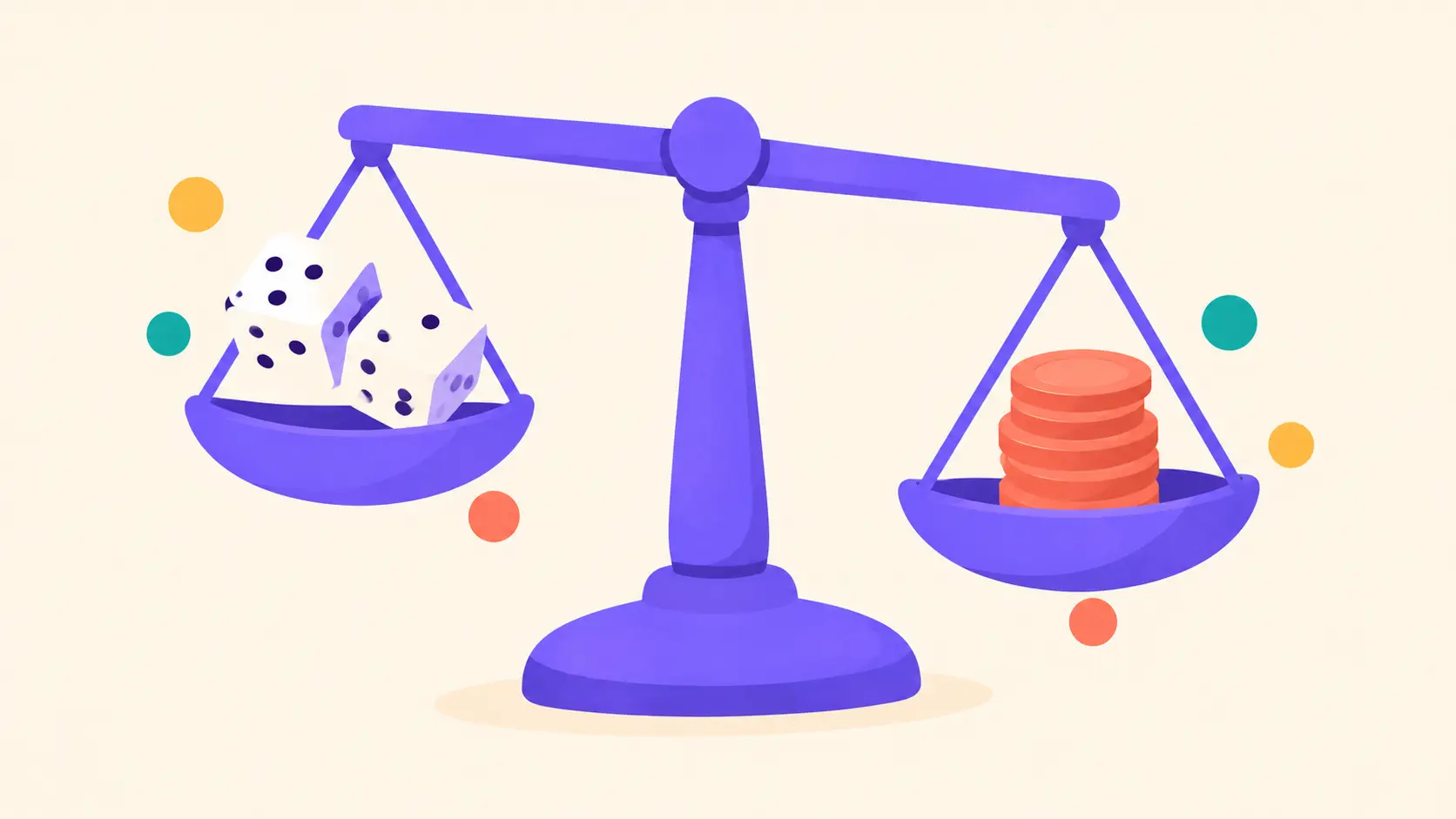
“Is backgammon about luck or about skill?” is the question asked about the game more often than any other. The short answer: both, on different scales. Over a single game the dice can decide everything. They do not go away after that — the longer the match, the less any single roll weighs in the result.
What follows is what that difference is made of, and what exactly in the game takes skill.
One game: the dice can decide it
Chance here is not background noise, it works at full strength: luck can outweigh a difference in class, and a beginner beats a seasoned player from time to time. That is not a flaw but a property, and the property has both a price and a use.
The use is that you can sit down with anyone: a child occasionally beats an adult and the game stays interesting to both. The dice make every game its own, unrepeatable one, and many call that the chief pleasure of playing.
The price is that a single game proves nothing.
A match: the gap comes back
Over distance the picture turns around. In long matches and in tournaments skill wins, and the more games are played, the further the stronger and the weaker player drift apart. The same thought, put most carefully: luck is about a single game, skill is about a series of them.
Hence the shape of tournaments — not a game but a match to a number of points, which is how chance is squeezed out by the score.
How much skill there is
More than it looks from outside — but no number measures it. Splits like “seventy thirty” get passed around in both directions at once, skill first and luck first alike. That is a saying, not a measurement, and nothing can be built on it.
A useful comparison from outside: poker is held to have a higher luck factor than backgammon, and that is exactly what makes poker more attractive to the casual player.
What gets listed is rarely one ability but a set: reckoning the odds, positional flair, psychology, nerve, self-discipline and stamina.
Where the skill actually goes
Every play requires both. The dice hand you numbers; you decide what to do with them, and that decision is entirely yours.
The cube is the hardest part: knowing when to offer a double, and when to take or drop, is one of the toughest skills in the game.
Underneath it all lies one balance — risk against reward. A game is made of calculated risk, and the good play is the one with the best expected result, not the one that looks safe. That same skill travels off the board: “how much am I prepared to stake at these odds” is an ordinary decision in life, and backgammon trains it well.
The cube reduces the part luck plays
The doubling cube is not merely a stake. It makes the game deeper and cuts the luck factor down: a player with an advantage can charge for it, and a player in a bad position can leave the game cheaply. The details are on the cube page.
Why the game is taken for a game of luck
From outside it is a game with dice, and the uninitiated call it a game of luck. The reason is not the dice alone: the game is perceived differently from static games like chess precisely because a roll is in it.
There is a second reason, and it is about people: the perception of luck weighs heavily on the psychology at the board. A lost game is easier to blame on the dice than on one’s own play — and that gets in the way of learning.
The argument was once settled in law as well: an American court held backgammon to be a game of skill and not a game of chance. The case, its year and its circumstances are on the history page.
What follows from all this
Study pays: results over the long run reward study and improvement. The more you play, the faster you recognise familiar positions. The quickest to improve are those who play regularly, go over their games with a program, know the standard opening plays and keep a few probability tables in their head.
And the calming converse: one lost game says nothing about you.
Comments