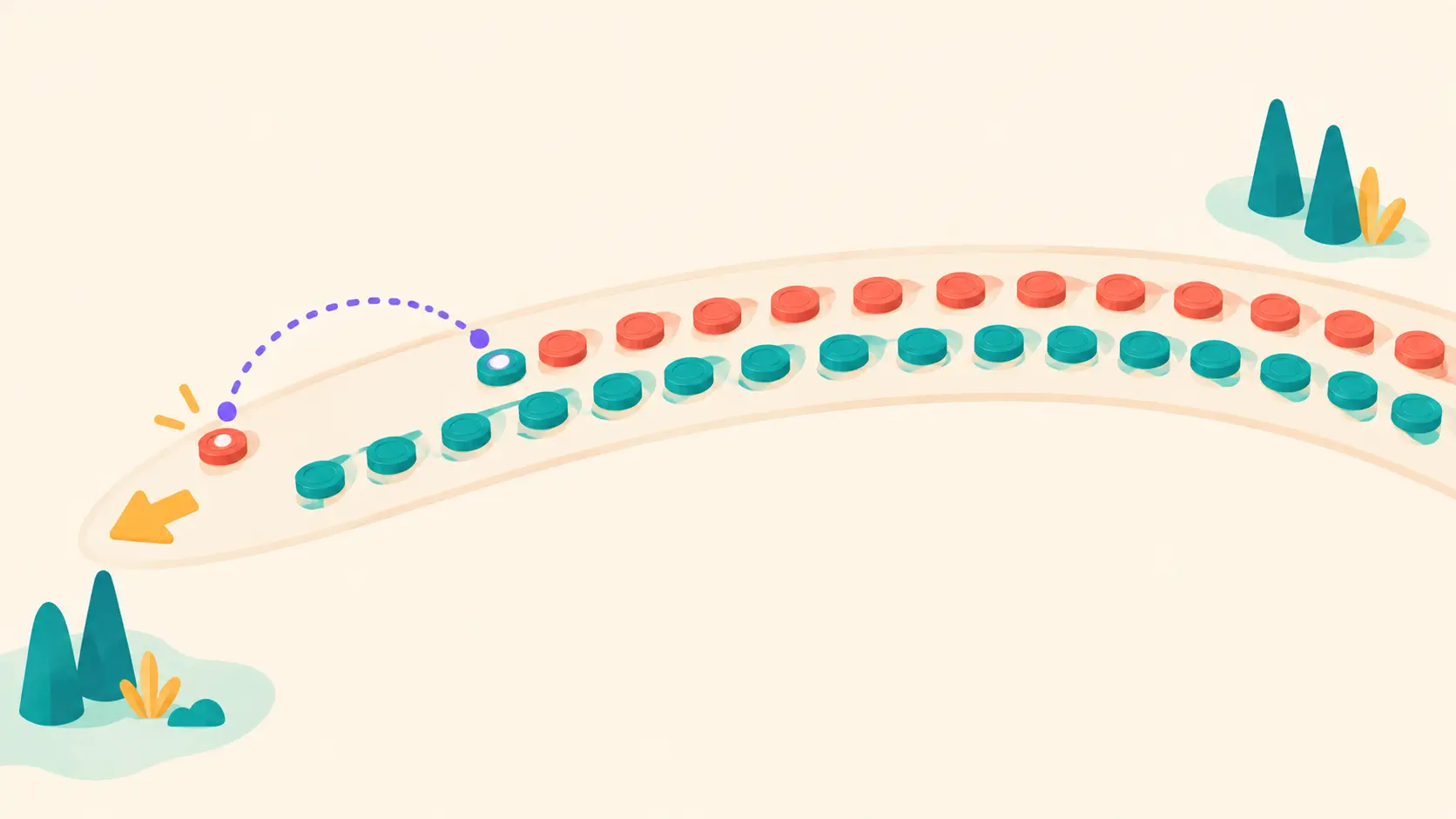
The pip count is the number that tells you who is ahead in the race: the sum of the pips a player still has to travel to bring every checker home and bear it off. Lower means ahead.
The place to start: counting only your own pips tells you nothing. The number means something only against your opponent’s.
The second is that ignoring the count is not an option, and it is a common mistake: not knowing who leads the race leads to bad decisions, in checker plays and above all with the cube. The cure is simple and dull — count regularly.
Five ways to count
The straight count. Add up the distance of every one of your checkers to the exit. What you add is not checker after checker but point after point: multiply the checkers standing on a point by the point’s number. Exact and slow.
From a reference point. Memorise the opening count — 167 — and then count not the position but the travel: how many pips each player has moved. The difference gives the current standing.
The starting position, which is also the reference point: the two sides are level. This is the one number to hold in your head by heart — from then on what you count is not the board but the distance travelled.
Cluster counting. A technique devised by Jack Kissane, a backgammon master: the checkers are gathered in the mind into recognisable shapes, and what you add is not point after point but a few chunks at once. He says himself that he takes almost any position in five seconds, and he set his methods out in an article called “Cluster Counting”. For the middle game this is the fastest method, and there is almost always more than one correct way to split a position, so the one you saw first will do.
The same work in two chunks instead of a run of points: the marked wall is one chunk, the stack further out the other. Adding two numbers is quicker than adding a row of them.
Half-crossovers. A way of arriving at an approximate count, which is usually enough, and which can be refined with a few extra calculations. Fast and less precise.
Counting the difference. Rather than holding two numbers, hold one: the difference between your count and your opponent’s, updated after every roll.
A pure race: the sides have passed each other and can no longer interfere. Such a position needs one number rather than two — how far ahead one side is — and that is what gets updated after every roll.
Two key points are used most often in counting: the five-point and the twenty-point, which is the opponent’s five-point.
Precision: where the straight count lies
The straight count is rough, and this is known. It “does only a rough job of lining up points of equal equity”, because it does not account for wastage — checkers placed so that bearing them off will cost more rolls than it should. Any formula that does account for wastage does significantly better.
Two are named: the Thorp count and the Keeler count both beat the straight count in all but very long races.
There is a second correction besides wastage: crossovers, a checker moving from one quadrant to the next. The number of crossovers needed before bearing off can begin is, alongside the pip count, a good estimate of where the race stands. Extra crossovers, on Kleinman’s account, are generally significantly harmful.
When the number decides everything
In a pure race, almost everything. With no contact left, the pip count is practically the only factor in cube decisions, and the most reliable guide in such positions.
With contact remaining, one factor among several. Beside it stand board structure, blot exposure and checker distribution. The count stays useful, but stops being the whole story.
What to do with the number
The rule is simple and repeated in several languages: ahead in the count, race. Avoid contact and take your checkers home. Behind, do the opposite — keep contact and look for a shot, which is what keeps you in the game.
There is a third option for the leader: the holding game. With a significant lead in the count, keep it by cramping the opponent: such a position is played defensively.
The cube: the numbers worth knowing
Here there are specific numbers, and they are not the same everywhere.
- an 8-12% edge in the adjusted count (the Thorp count) is grounds to double;
- around 8-10% or more means doubling is allowed;
- 8% — a money-game rule of thumb: when the trailer’s count is that far behind, the leader should make an initial double;
- 10% on entering the home board generally justifies a double in racing positions.
What such an edge means: 10% — say, 90 against 100 — is roughly a 10-15% edge in win probability, a strong double in most situations. A plain 10-pip lead corresponds to a win probability of about 64%.
Knowing the count is what decides double, take, or drop in a pure race. That decision comes up once or twice a game — and those are the moments when the count has to be exact.
The count does not end when bearing off begins
Even while checkers are coming off, the pip count still says who is ahead. And it is worth checking before decisions about bringing checkers home, not after.
How to learn it
The answer is dull and singular: practice. With regular practice the count becomes an automatic background process — that is, it stops costing the attention the game needs.
The overall picture of plans is on the strategy page, the cube in detail on the cube page, and the end of the game on the bear-off page.
Comments