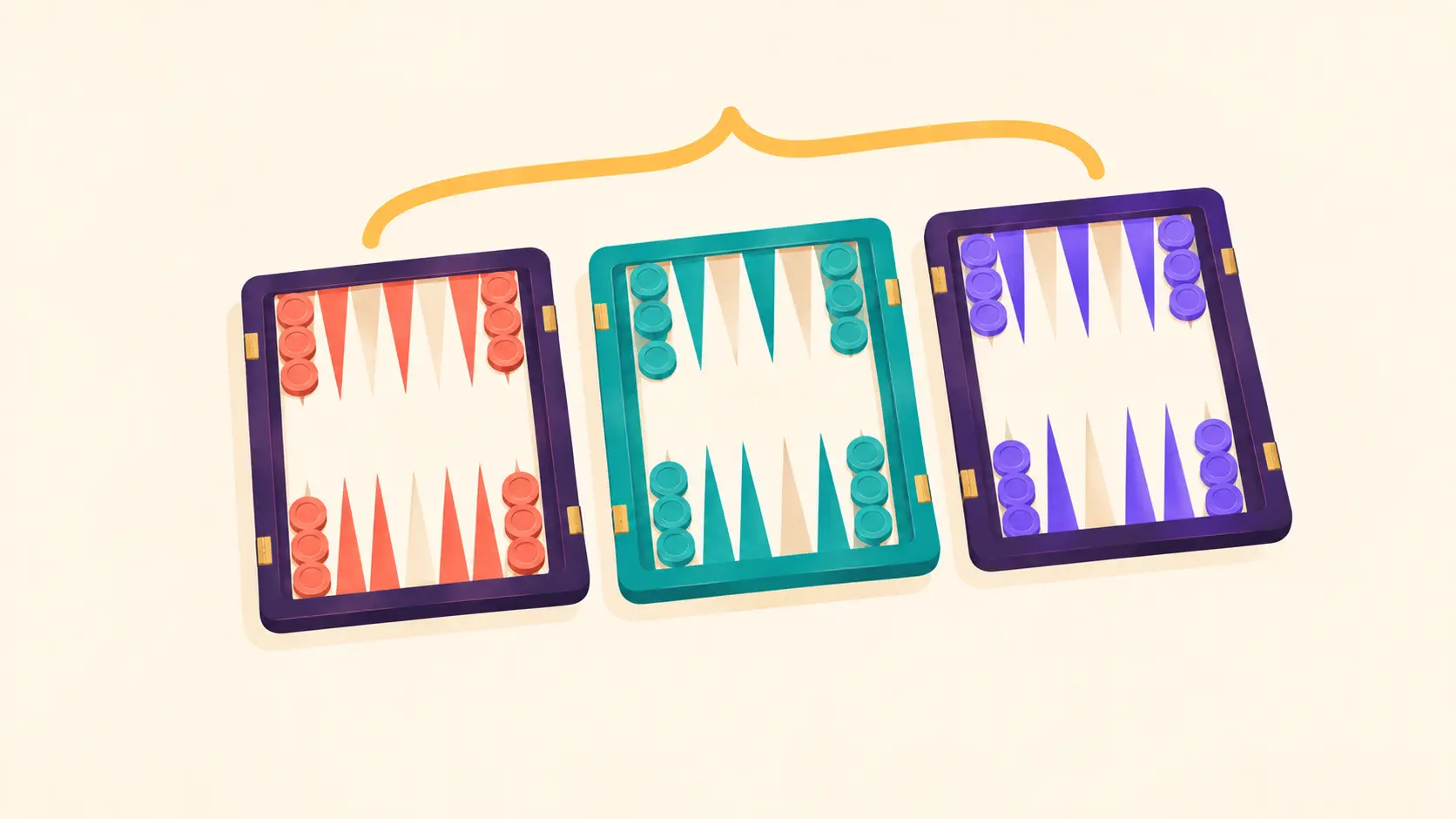
The board is the same for all these games: twenty-four points, fifteen checkers each, two dice. Two players, and the winner is whoever bears all their checkers off first.
Everything else divides along three lines: which way the checkers travel, what happens when they meet, and where they start. Three differences are enough to produce games that share almost nothing — not the arithmetic, not the plans, not even how a match feels.
Three differences that make all the variants
Direction. In Narde and Fevga both players travel the same way — counter clockwise, each toward their own home board. In backgammon and Plakoto they travel toward each other.
Contact. In Narde and Fevga there is no hitting at all: a point holding even one enemy checker is simply closed to you. In backgammon a lone checker is hit, goes to the bar and must re-enter. In Plakoto it is neither hit nor sent anywhere — your checker sits on top of it and holds it where it stands.
Setup. In Narde all fifteen checkers stand on the head. In Plakoto they also start as a single stack, but on the opponent’s starting point. In backgammon they are spread across four points.
These games have more in common than first appears: one board, the same scoring for a win, doubles played four times, and a doubling cube that works the same way in backgammon and in Narde. Greek tavli, by contrast, does not use it.
Narde: a game where nothing ever meets
The checkers travel a full circle counter clockwise, enter the home board and are borne off. There is no hitting: you cannot place a checker on a point held by even one enemy checker. So the whole fight is about points and tempo, never about checkers knocked off.
Two rules follow from that, and neither exists anywhere else.
The head rule. One checker leaves the head per turn. The exception is the opening roll: on 3-3, 4-4 and 6-6 two may leave. More on the rules page.
The ban on an impassable block. Six consecutive occupied points cut the board in two — there is no way round them. So such a block may only be built while at least one enemy checker is already ahead of it; trapping all fifteen is forbidden.
Fevga: the Greek relative of Narde
Fevga is one of the three games of Greek tavli, and it is built almost exactly like Narde.
What matches is the essential part: no hitting — no blots sent away, no bar, no pinning. Both players travel the same way, counter clockwise, from the first point toward the twenty-fourth. A point holding your checker is closed to your opponent. All fifteen checkers must reach the home board before bearing off may begin.
The setup differs: both players’ checkers stand at the same end of the board — white on the twenty-fourth point, black on the twelfth.
A wall of consecutive closed points is τοίχος in Greek, and it means what our block means: the longer it is, the harder it is to get past. Fevga is called the expert’s game precisely because, with no hitting, everything rests on structure rather than on the luck of a meeting.
The kinship is well established: Fevga resembles Narde in having no hitting and a shared direction, and the Russian and Iranian relative of Fevga is called Narde. In Greece our game is itself called Fevga.
Plakoto: pinning instead of hitting
Plakoto is the second game of tavli, at home in Greece and the Middle East.
Setup: all fifteen checkers as one stack on the opponent’s starting point, the twenty-fourth. The players travel toward each other, as in backgammon.
Pinning instead of hitting. Landing on a point with a lone enemy checker, you do not send it to the bar — you place your checker on top of it, and it freezes. It moves again only once you leave that point. Plakoto has no bar at all, and nothing to re-enter from.
Consequences follow that exist in neither backgammon nor Fevga:
- a point counts as closed not only with two of your checkers on it, but also with one of yours pinning an enemy checker — a pinned checker works for you;
- the last checker left on your own starting point is called the mother, and an opponent who pins it wins at once;
- if both mothers are pinned, the game is a draw;
- bearing off may begin only once all your checkers have reached the home board — the free ones and the pinned ones alike.
The immediate loss when your mother is pinned is played differently: you either lose at once or concede a gammon, depending on what the players have agreed. That is a house rule, not a regulation.
Portes: Greek backgammon
The third game of tavli is Portes, and it is the closest of the three to Western backgammon: here a lone checker is hit and sent to the bar. Portes is what people mean by “Greek backgammon”; the full set of tavli is Portes, Plakoto and Fevga, played one after another, game by game.
What this means for a player
If you come from backgammon, Narde and Fevga will ask you to forget half of what you know: no bar, no trading hits. What remains is structure alone — and that is exactly why Fevga is called the expert’s game.
If you have only ever played Narde, what will surprise you in Plakoto is not the hitting — there is none there either — but that one of your checkers can hold an enemy checker in place, and that a game can end on your opponent’s very first move.
Comments