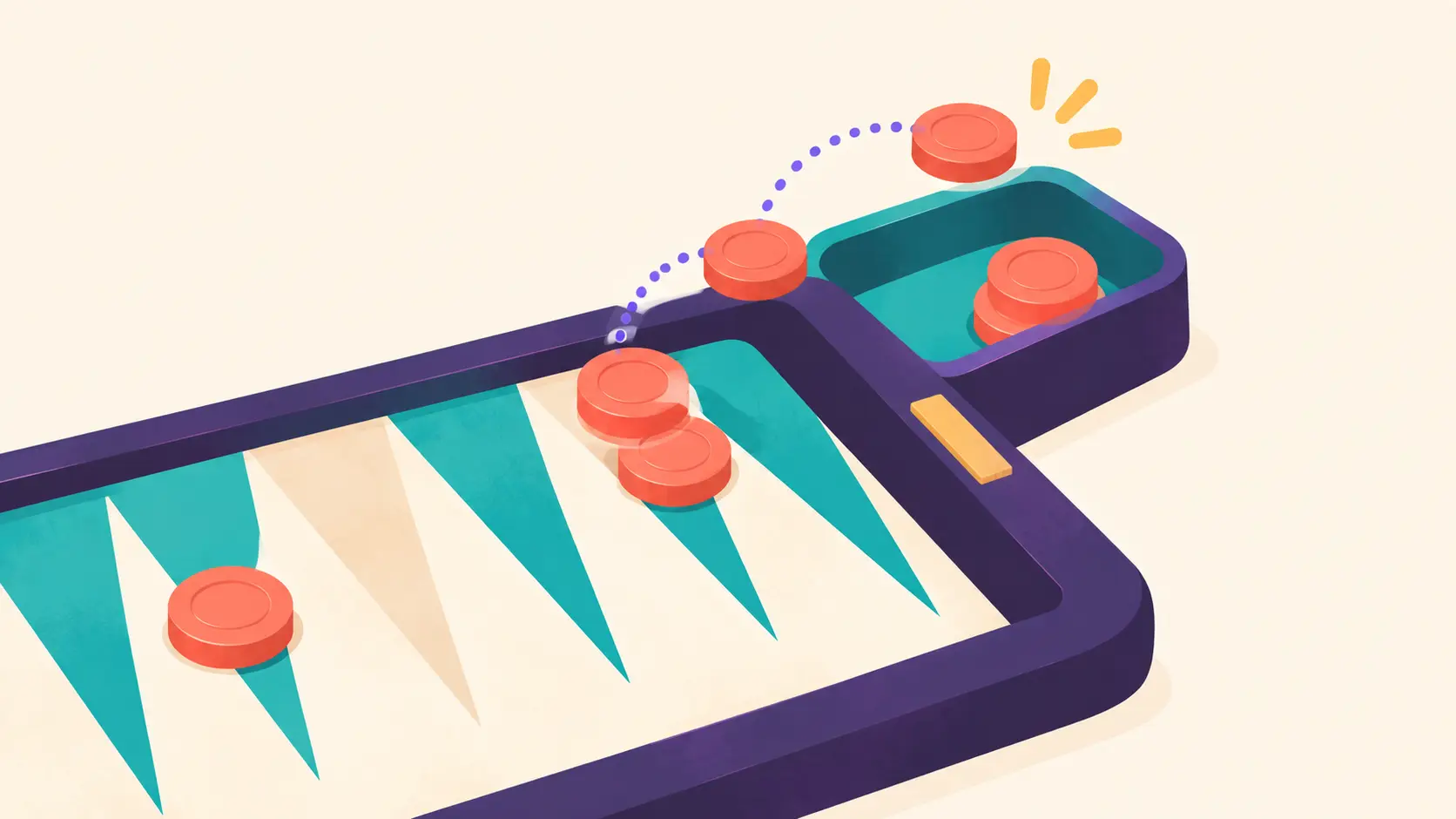
Bearing off is the last phase of the game: the checkers are home, and they come off the board. From the outside it looks like a formality whose outcome is already settled. It is not. Wins and losses are often decided by how efficiently a player bears off: a bear-off that looks simple can be an expert-level problem, and almost everyone plays it wrong, experts included. Clumsy bearing off is one of the standard beginner’s mistakes.
When bearing off begins
The formal condition is single: checkers may come off only once all fifteen have reached home. That has a consequence for the whole game, not only its end — back checkers have to be escaped, because until they come home bearing off never starts at all.
But “may begin” and “should begin” are different things, and both sides of that are worth seeing.
A common error is haste: a player rushes to take checkers off without having closed their home board, and hands the opponent extra chances. The opposite case happens too: when you are behind on the pip count, what matters is to get the checkers home by any move at all — all of them onto the six-point and the five-point if that is what it takes — and to start taking them off. Where you are behind, tempo is worth more than a tidy position.
The race: when only speed counts
Bearing off is simplest where contact is gone: the sides have passed each other, there is nobody left to hit. Here the task is single — take checkers off as fast and as efficiently as possible. The player ahead on the pip count aims at one thing: to cut down the number of rolls left to make.
There is a second reason not to linger. Until you have borne off a single checker, you are still gammon material.
The home board is built before the first checker comes off
The central idea of this phase: the bear-off is not won during the bear-off. It is won while the checkers are still being brought home.
The measure here is not the pip count but wastage — checkers placed so that taking them off will cost more rolls than it should. Wastage matters as much as the raw pips: the count can be in your favour while the position it describes is a wreck.
Hence the advice:
- do not pile checkers on the near points. A stack on the one-point and the two-point is the most wasteful shape there is: it eats roll after roll;
- bring checkers in from the outer board aiming at the six-point and the five-point — from there they come off without waste;
- do not leave gaps. An empty point in the home board hurts the bear-off, so a die that cannot take a checker off is spent filling — moving a checker down from a higher point onto the six-point or the five-point;
- do not stack. If neither die can bear a checker off, spread the checkers across points instead of building towers;
- where possible, bear off so that every occupied point keeps at least two checkers.
Two pictures, and the difference between them is everything said above.
This is what a wasteful home board looks like: a stack on a near point and a gap (marked) where a checker is needed. Dice that land on the gap take nothing off.
The same fifteen checkers laid out evenly: every number has something to take off, and no roll is wasted.
That last one is no longer about efficiency but about safety, and safety comes next.
Measuring what is left
In a race the position is judged by a number, and there are two ways of counting. The count by throws estimates how many rolls it will take to bear off every checker. The running count adds up the pips still to be travelled before all of them are off.
The pip count itself matters most in the endgame, when both sides are simply racing, and is most reliable in a pure race, where no contact remains. The other side of the same statement: where contact does remain, one number does not describe the position.
While contact remains
Everything changes when enemy checkers are still sitting in your home board.
The first rule is not to hurry: an opponent inside your home board can hit you, and the setback is dramatic. A blot left during the bear-off reverses the result of a game that looked won. The reverse holds too — a successful hit during the bear-off turns a loss into a win.
Here is the position in question:
White — borne off: 5
Contact: the opponent’s anchor sits inside White’s home board (marked), waiting. While it is there, every bear-off that leaves a checker alone is a chance handed to the opponent, not merely a wasteful play.
The same mechanism seen from the losing side: to concentrate on taking checkers off while neglecting to keep your points closed is to give the opponent the small chance he needs to win a lost game.
The mechanics of that chance are simple: if your opponent leaves a checker exposed while bearing off, it goes to the bar — and holding two checkers on one or two points of his home board is exactly what buys you the opportunity. And whoever lands the hit inherits the next task: to contain the checker he hit, keeping it from escaping his home board while he bears off.
Hence the cautious manner of play: watch the enemy checkers that could come back into the game, do not leave your own exposed, keep your checkers placed so that the opponent’s moves are cramped. This is the conservative strategy, and its purpose is direct — to reduce the risk of losing checkers during the bear-off.
Two dangers stand apart:
- a high point that is hard to clear. If the opponent holds an anchor deep in your home board, clearing a high point without leaving a blot may not be possible at all;
- the enemy wall. During the bear-off you must not let your opponent build a prime of six consecutive closed points.
The other side: waiting for a shot
A bear-off always has two participants, and the second one is not taking checkers off — he is waiting for a mistake. How the bear-off plays out depends on where the opponent’s anchors are.
The best anchor to wait on is the golden one, on the opponent’s five-point: it is closest to the gap you need to exploit, and it threatens a shot if he misplays the bear-off. Next comes the opponent’s four-point — strong pressure and good shot threats at exactly this stage. From the golden anchor you have direct shots at blots on his one, two, three, four, six and seven points.
The weakest waiting position is the ace-point game: escaping from it is close to impossible and the threat of a shot is small. The best back-game structure is the pair of the one-point and the two-point: adjacent low points cover the widest range of bear-off combinations, so if the opponent exposes a checker anywhere in his home board, your chance of hitting is high.
Breaking the anchor and running is tied to three conditions: the race has become close enough to run profitably; no realistic shots remain in the opponent’s bear-off; or the dice force it.
And the mirror remark for the player taking checkers off: a prime in your own home board earns its keep at exactly this stage — when the opponent is trying to come back and start bearing off.
The cube during the bear-off
Bear-off positions are named as good doubling opportunities: if you are bearing off efficiently and your opponent is not, the cube is worth offering. The common beginner’s error here is the opposite — standing in a strong bear-off position and forgetting that doubling exists at all.
Gammons are a separate line. A checker sent to the bar raises the gammon threat: an opponent stuck there, unable to re-enter, bears off none at all. In awkward positions where you want the gammon without putting the game itself at risk, playing for the gammon is still right.
What players argue about
One question is answered differently: which checkers to take off first.
One piece of advice is to take the further-back checkers off first: that way fewer chances are lost and the game proceeds to plan. Another says the opposite, start with the most advanced ones; a third, with those already safe.
It does not reduce to a single rule. Different advice describes different positions on the board, and the right order depends on which one you are holding.
The second remark applies to all the advice at once: the ideal positions on which bear-off technique is taught rarely arise in real games.
How to learn it
A simple exercise for that: set both players’ checkers evenly in their home boards and play the bear-off phase alone, nothing else. The basic idea of backgammon is visible that way, with no opening and no fight for points.
The same exercise, put to children, is shorter still: this is the fun part — roll and take them off.
The overall picture of game plans is on the strategy page, doubling in detail on the cube page, and the terms in the glossary.
Comments