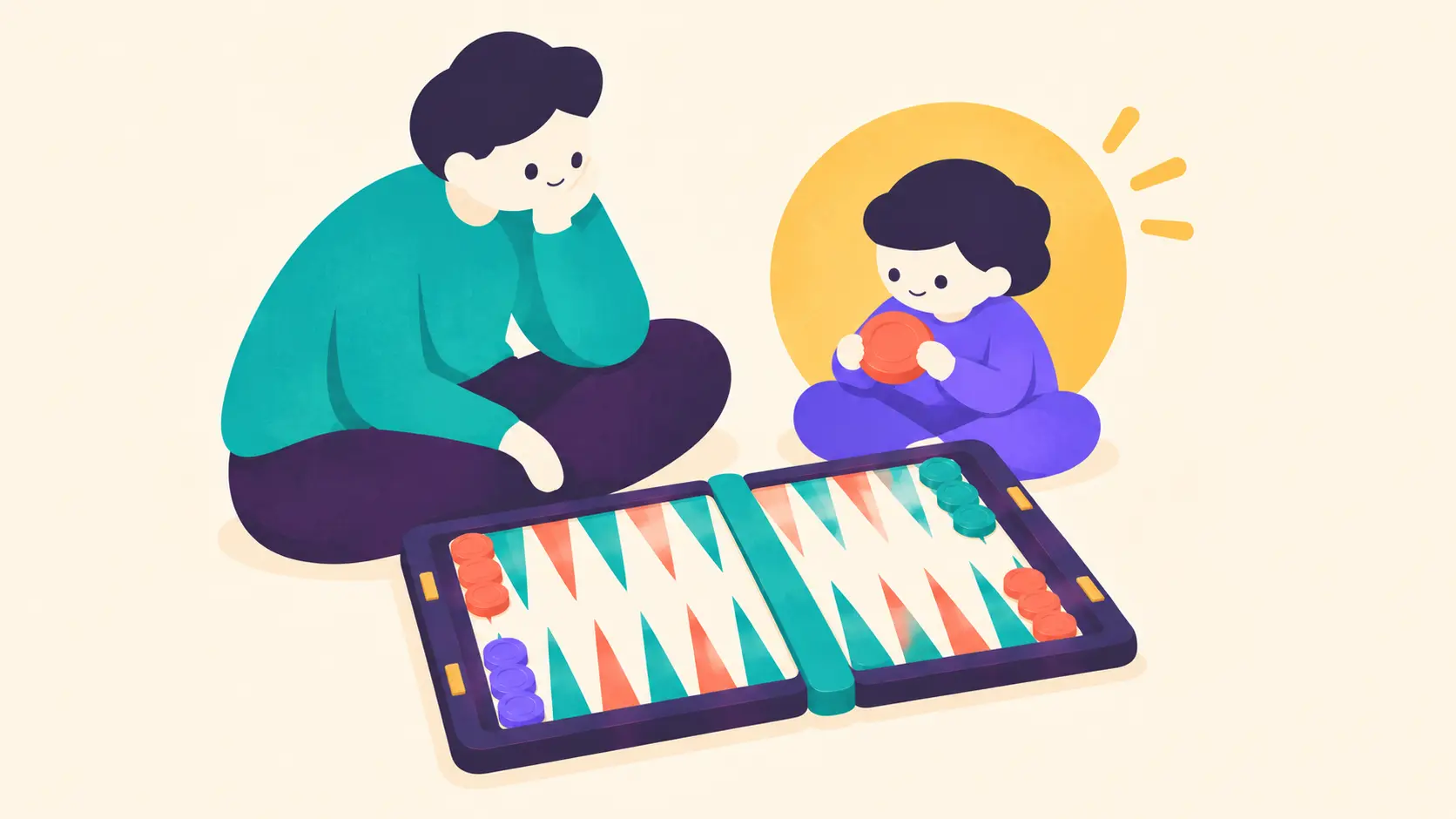
Backgammon is a beginner-friendly game: the rules are quick to learn, and it is usually the more accessible choice among comparable games.
What follows is where to begin, which mistakes everyone makes, and what the game gives children besides itself.
Where to begin
Simple rules, checker movement, rolling the dice — step by step and visually. That is how both children and adult beginners are taught: simple rules first, quick learning, and an understanding of the basic logic of movement.
There is also a simple exercise: set both players’ checkers evenly in their home boards and play the bear-off phase alone. The basic idea of the game is visible with no opening and no fight for points. Put to children, the same phase gets shorter still: this is the fun part — roll and take them off.
In the Middle East children are often given a different game first — Blocking Backgammon, whose strategy is easier than the other variants’.
The cube is left for later: beginners usually do not use it. The advice is direct — basic rules first, and turn to the cube once checker movement and bearing off stop taking effort. Separately, and reassuringly: a novice is not expected to calculate take points, count pips, memorise match equities or understand gammon prices.
Knowing when to accept or decline a double is a skill of its own — precisely the one that separates a beginner from an experienced player, and one worth taking up once the cube itself stops being new.
What to learn first
Take the five-point as early as possible — the number one piece of advice for a beginner.
Four opening rolls that make a point: 3-1 the five-point, 4-2 the four-point, 6-1 the bar point, 5-3 the three-point. These are the strongest rolls of the opening, and all four are played the same way: take the point. Learn 6-5 fifth — it is the one roll with exactly one play, 24→13. The other ten are more disputed, and they are covered on the opening page.
Two specific beginner recommendations: on 5-1 prefer splitting the back checkers and learn to slot later; on 6-3 play 24→18 and 13→10 rather than running a single checker to the fifteen-point — running there is hit by thirteen rolls out of thirty-six.
The mistakes everyone makes
The useful part is that the mistakes come in pairs: one from too much caution, one from too little.
-
playing too safe. A common error: the beginner avoids contact where they should be hitting;
-
but the urge to hit is the right instinct, because backgammon is a game of aggression. It should be aimed, not suppressed;
-
moving without a plan — pushing checkers forward without looking at blocks, lone checkers, or the opponent’s design;
-
missing the chance to hit and missing safe points and blocks — two sides of the same inattention;
-
not seeing the danger in stacks. A beginner sees no problem in a pile of checkers; an expert knows it has to be developed;
-
bringing checkers to the one-point and two-point, which look safe because they cannot be overshot;
-
slow to double and quick to pass. Beginners and intermediates avoid cube decisions that shorten the match, and dislike putting the match on the line straight away.
-
taking up the prime too late — the wall of consecutive points gets built not early but at the moment it is already needed;
-
over-splitting the back checkers — a habit a beginner reaches for more often than the position asks for.
And a general observation: many beginners simply do not know parts of the rules, and lose opportunities far too easily because of it.
Why a child sometimes beats an adult
What matters here is the structure of the game rather than upbringing.
At checkers a beginner almost never beats an expert — there is no luck to equalise the outcome. At backgammon they do — in a single game, on lucky dice. Over a match a skilled player will almost always win, but any one game stays open.
Hence a practical consequence: a child and an adult can play as equals, and it is not indulgence. There is a social side too: the backgammon community gives children a rare chance to meet and interact with adults on an equal basis.
What the game gives besides the game
The list turns out to be a long one.
- confidence: the game gives a child something to be proud of and to feel special about;
- a pastime for the whole family, in which reasonably young children compete with adults quite seriously;
- arithmetic without a textbook: children pick up basic counting and in time more complex ideas — odds and statistics, down to understanding that there are more ways to be hit from six pips away than from some other distance;
- probability and percentages are taught in school with this game;
- numeracy: many teachers report that children who play board games regularly count better;
- and it is a better diversion than mindless video games or cartoons — available at practically any time.
For a beginner online is a good option too: more games, and an opponent found at once.
In order from here: the rules, then the opening and bearing off, and once movement stops taking effort, the cube.
Those who want to read further are pointed at one book: Paul Magriel’s Backgammon, the defining work and the best book for a beginner.
Comments